Diving & Snorkeling · Responsible Fishing
Spearfishing Isla Mujeres Guide: Apnea, Permits & Safety
What responsible guests should understand before entering the water with a spear.
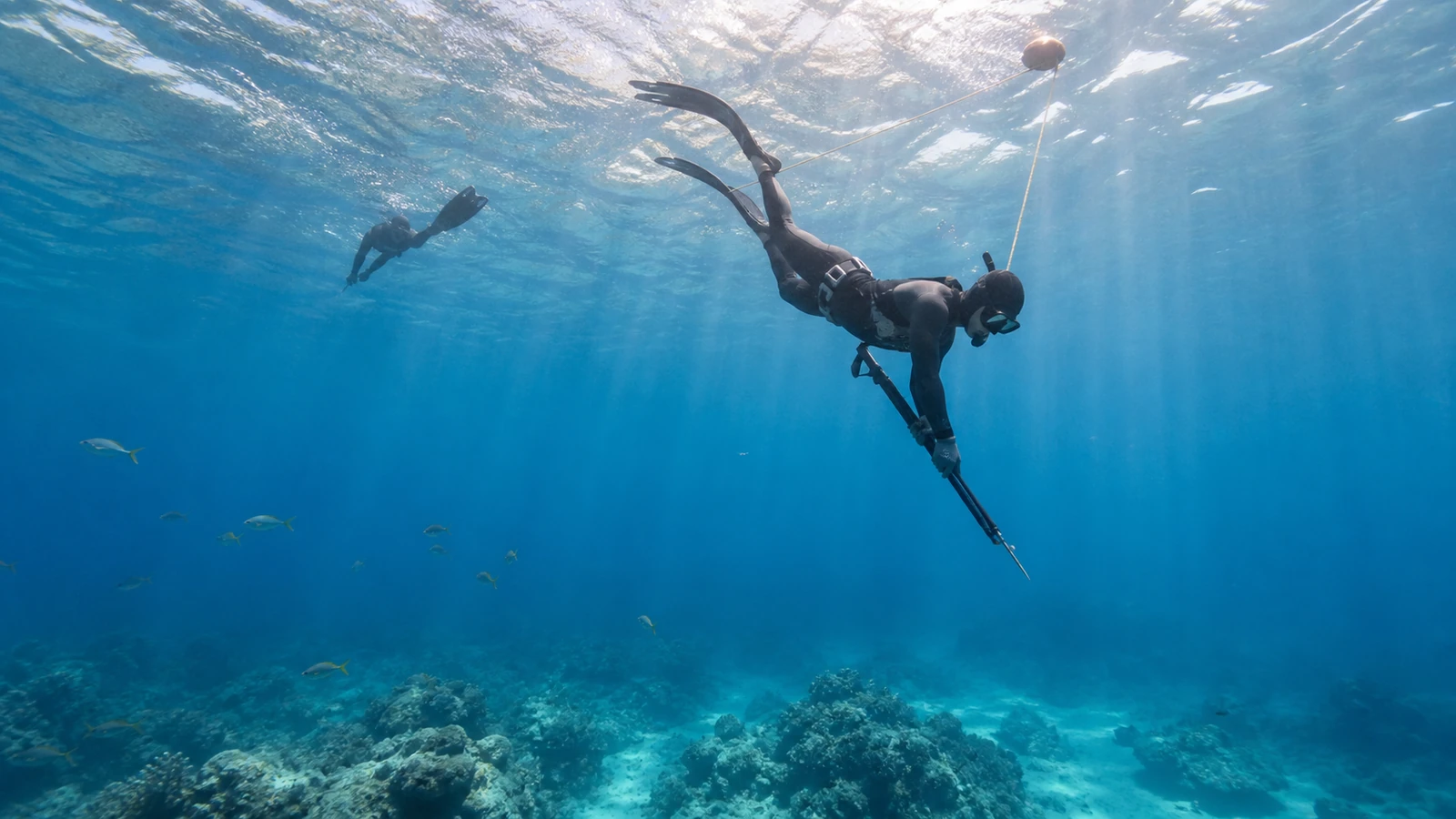
What spearfishing is—and is not
Spearfishing combines freediving, fish identification, underwater movement and selective fishing. The diver studies the surface, settles the breath, descends on one breath and decides whether a particular fish can be approached and taken legally, safely and cleanly. Most of the activity is not pulling a trigger. It is waiting, observing, positioning and choosing not to act when one part of the situation is wrong.
That makes it fundamentally different from dropping a baited line and waiting above the water. The guest sees the fish in its habitat and must identify its species, approximate size, direction and background before considering a shot. The fish can move away, the angle can disappear and the diver's comfortable breath can end. Respecting those limits is the discipline.
Adventure Tours offers apnea only. Scuba tanks are never used. A guided session is not a shortcut around swimming ability, open-water comfort or responsible judgment, and a catch is never guaranteed. Shore entry may be booked by one guest and accommodates up to two guests per guided session; each private boat accommodates up to four guests aboard, with larger groups coordinated through additional boats only after direct consultation.
Why local guidance matters around Isla Mujeres
The water around Isla Mujeres changes quickly across reef edges, sand, current lines and exposed coastline. Visibility in one area can be excellent while another is uncomfortable. An entry that looked easy in the morning can be affected by afternoon wind, and a productive place from the past can be closed, unsuitable or outside the legal plan today.
An experienced local spearfisher brings more than a memorized coordinate. He reads the entry and exit, watches the current, recognizes fish behavior, understands when a participant is becoming tired and knows when a seemingly possible shot should be abandoned. Years of practice also create a conservation instinct: a place remains useful only when divers refuse undersized, protected, uncertain or poorly positioned fish.
No article can replace that live judgment. This guide prepares you to understand the decisions, ask better questions and arrive ready to learn—not to operate independently in unfamiliar water.
The practical Mexican rules to understand
Mexico's federal guidance distinguishes underwater recreational fishing from ordinary fishing from land. Spearfishing requires an individual recreational-fishing permit, including when the session begins by walking from the beach. Each participant should carry the current documentation requested for the activity rather than assume the boat or guide's paperwork replaces an individual requirement.
The underwater modality is directed at fish. Federal guidance excludes crustaceans and mollusks except squid where permitted, and sets a maximum of five fish per underwater fisher per day. Minimum sizes, seasonal closures, protected species and rules for a particular area can be stricter, so the lower applicable limit always controls. The existence of a broad federal maximum does not mean every fish below it may be taken.
Rules and permit procedures can change. Review CONAPESCA's official recreational-fishing permit guidance and the NOM-017-PESC-1994 standard. Guests must provide accurate identification and permit information when requested, while the guide and captain determine whether the intended operation remains appropriate.
Distance offshore is not permission
There is no responsible shortcut such as “two kilometers offshore means legal.” Distance may be part of the operating plan, but protected areas are defined by zoning, coordinates and applicable rules—not by an imaginary circle around the beach. Moving farther offshore does not legalize a protected species, remove a closure or open a no-take zone.
The western marine park around Isla Mujeres includes areas where sport or underwater fishing is prohibited or specifically controlled. The captain and guide select a possible area using current boundaries, sea conditions and the day's requirements. They can change or cancel the plan when there is uncertainty.
Productive coordinates are not published. Broadcasting a location without its legal boundaries, conditions and conservation context would give readers confidence without the information required to act responsibly.
Shore entry versus private boat
Shore entry
The shore session begins on foot and uses no vehicle or boat transportation. Guests carry the required equipment with the guide, assess the water's edge and enter only when the route and conditions are suitable. It is the most direct version of the experience: beach, fins, breath and water with nothing in between.
That simplicity does not make it physically easy. The entry and exit are part of the session, and the diver must reserve enough energy to return through the same surf or current. It suits capable swimmers who are comfortable managing equipment and following instructions in changing coastal water.
Private boat
The boat gives the captain and guide more possible operating areas, surface support and the ability to reposition when conditions change. It can reduce the effort of a shore entry and provides a platform for equipment and rest, but it does not guarantee fish, perfect visibility or permission to enter every area.
Both formats run in one focused window from 2:00 to 4:00 p.m.. Shore entry may be booked by one guest and accommodates up to two guests per guided session; each private boat includes up to four guests aboard. Larger groups can be coordinated with additional boats, subject to guide and vessel availability and a custom quote. Compare the current shore-entry and private-boat options and prices before describing your group's swimming and freediving experience to the team.
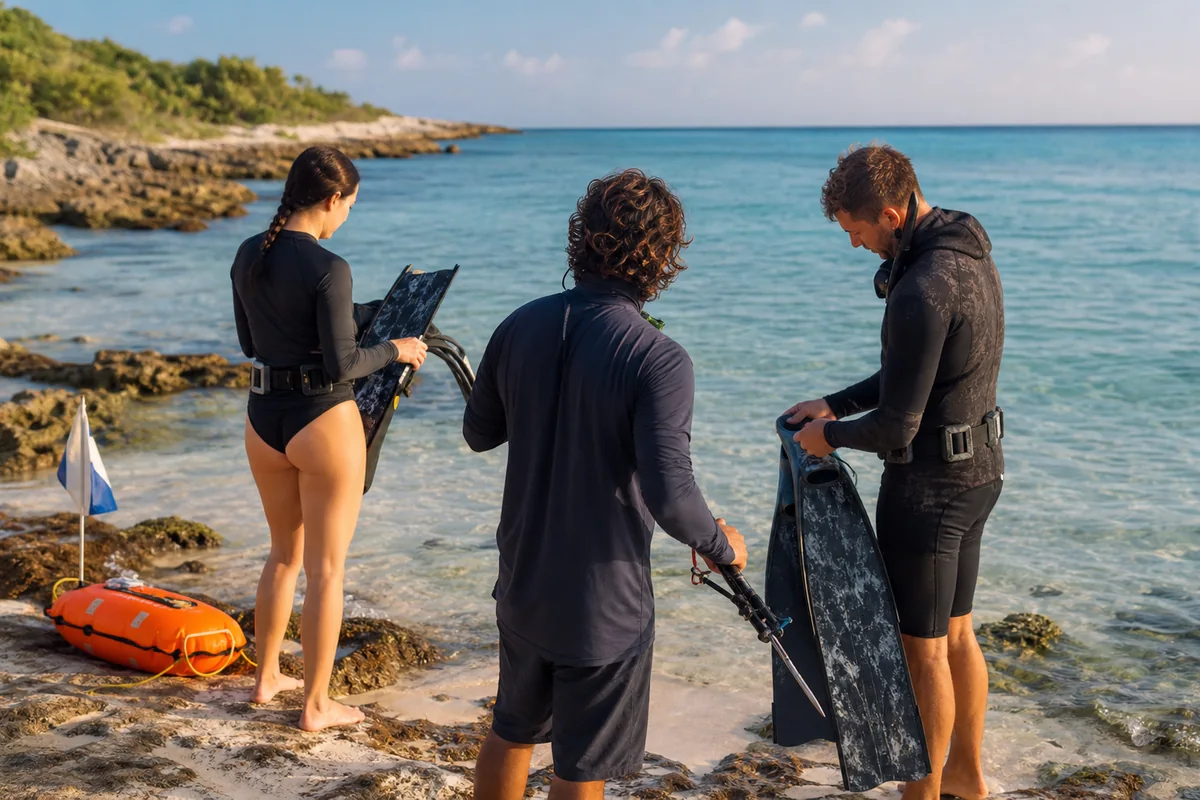
What the equipment is designed to do
- Low-volume mask and snorkel: support clear vision and relaxed surface breathing without unnecessary bulk.
- Long freediving fins: create efficient movement but require control around a buddy, boat and reef.
- Exposure protection: reduces heat loss, sun exposure and minor contact without authorizing contact with the bottom.
- Weight system: must be configured conservatively and include a release the diver can operate immediately.
- Spear: is carried, loaded and unloaded only as directed; it is always treated as a weapon.
- Float and flag: improve surface visibility and help organize equipment or a legal catch according to the guide's system.
Do not bring unfamiliar gear and attempt to learn it silently in open water. Tell the guide what you own, what you need and whether you have used the same type of equipment before. A two-hour session becomes much more valuable when fit and basic operation are settled before the first descent.
Essential freediving and spear safety
- Never freedive alone; maintain an active one-up, one-down buddy system.
- Do not hyperventilate before a descent or turn breath-hold time into a competition.
- Keep the spear unloaded until the guide confirms it is appropriate to load in the water.
- Never point a spear toward another person, boat, line or uncertain target.
- Identify the species, size and background completely before considering a shot.
- Stay within the guide's area and use the visible float or flag system as directed.
- Tell the guide about medical conditions, medications, recent illness and alcohol use before entering.
- End the session when fatigue, cold, current, anxiety or poor visibility reduces judgment.
A freediver can appear calm immediately before losing control. That is why supervision continues through the ascent and recovery at the surface, not only while someone is underwater. The guide's instruction to rest, move, unload or stop is final.
The shot you refuse is part of the experience
Responsible spearfishing is selective only when the diver actually passes on unsuitable opportunities. A fish may be too small, protected, out of season, difficult to identify, positioned against unsafe background or too far away for a clean shot. Excitement does not improve any of those facts.
Never fire at a silhouette. Identification must happen before the decision, not after retrieval. If there is doubt about species, size, angle or what lies beyond the target, the correct action is to watch the fish leave. That restraint protects the reef and also keeps the diver from turning a learning experience into an avoidable problem.
A guide may impose a more conservative choice than the maximum written rule. Legal does not always mean wise for a particular place, day or participant.
How to prepare for the two-hour session
- Describe your real swimming, snorkeling, freediving and spearfishing experience before confirmation.
- Share your comfortable depth rather than your deepest past attempt.
- Disclose medical conditions, medications, recent illness and ear or sinus problems.
- Sleep, hydrate and avoid alcohol before the session.
- Eat a light meal that leaves time for comfortable water activity.
- Bring sun protection, water, towel and dry clothing.
- Arrive ready for the selected format and the confirmed meeting instructions.
Do not train aggressively for breath-hold records immediately before the activity. The aim is a calm, repeatable session with enough reserve for an unplanned swim, not one dramatic descent followed by exhaustion.
What makes a session successful
A good session may produce a legal fish, a missed opportunity or no safe shot at all. Wildlife does not follow a reservation calendar. Visibility, current and individual ability determine how much of the afternoon happens below the surface, while selectivity determines how many opportunities are deliberately refused.
Success can mean learning to move quietly in long fins, completing calmer descents, reading fish behavior, recognizing a legal target or understanding why the guide changed an area. If a responsible fish is taken, it is the result of those decisions—not a product that could be guaranteed in advance.
Guests whose main desire is to observe marine life without fishing should choose guided snorkeling, reef diving or study the Isla Mujeres dive-site guide. Each path reveals the same marine world through a different discipline.
Frequently asked questions
Are tanks used?
No. The activity is breath-hold freediving only; scuba spearfishing is not offered.
Does the boat simply travel two kilometers offshore?
No. Distance can be part of the operating plan, but exact legal zoning, protected areas, current rules and conditions determine the location.
Do I need an individual permit for a shore-entry session?
Yes. CONAPESCA's guidance treats underwater recreational fishing as requiring an individual permit, even when the diver enters from shore.
Is a fish guaranteed?
No. Conditions, wildlife and ability vary, and responsible fishing requires passing on unsuitable shots.
Can complete beginners participate?
Previous spearfishing is not always required, but capable swimming, open-water comfort, honesty and the guide's approval are essential. Suitability is reviewed before confirmation.
Shore or private boat
Discuss Your Experience Before Booking
Tell us whether you prefer shore entry or a private boat, how many people are in your group, and describe their swimming and freediving experience.
Message Adventure ToursView the serviceContinue planning
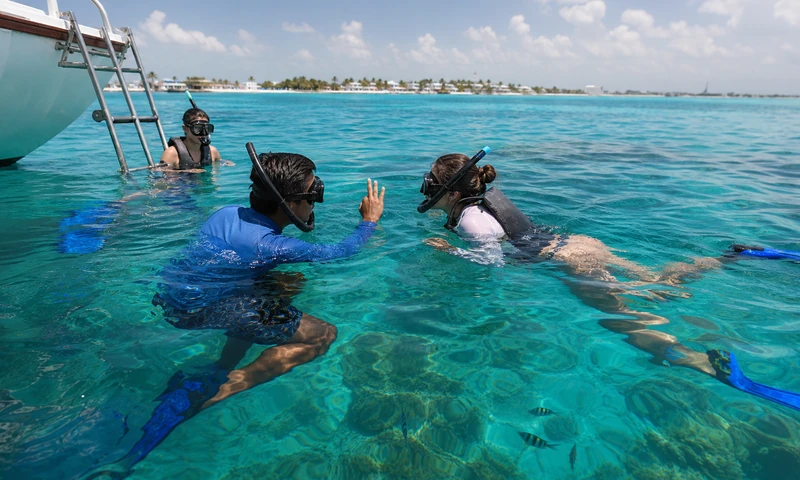
Snorkeling for Beginners
Build open-water breathing, finning and reef awareness before adding the demands of a spear.

Isla Mujeres Dive Sites
Understand the reefs, currents, protected areas and underwater terrain surrounding the island.
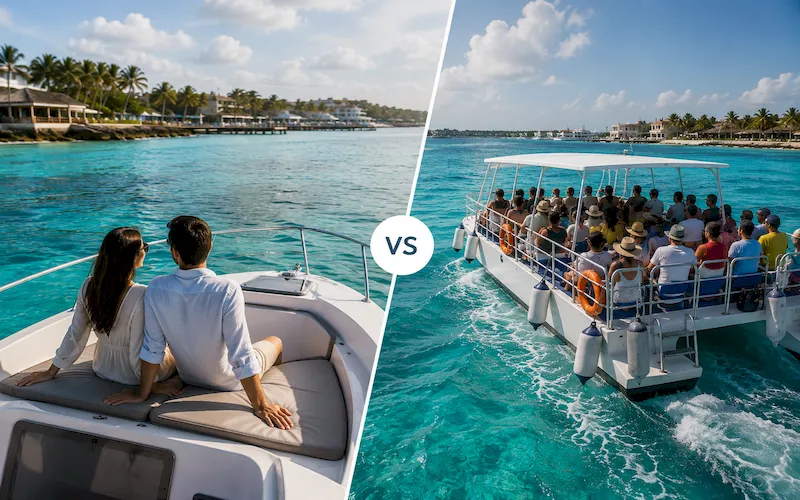
Private vs Shared Boat Tours
See what a private vessel changes when mobility, attention and operating flexibility matter.