Private Cavern Diving
Customized Diving Plan
MXN $5,000
starting price
(The final total is confirmed after reviewing the cenote, transportation, entrance fees, equipment, guide requirements, and itinerary.)



The Underground World of the Yucatán Peninsula
Beneath the limestone of the Yucatán Peninsula lies one of the world’s most extensive networks of flooded caves. Cenotes provide access to an environment shaped by freshwater, ancient geological change, mineral formations, submerged passages, and the movement of water between the interior of the peninsula and the Caribbean.
Diving here is entirely different from diving an ocean reef. Visibility can be exceptionally clear, natural light enters through cenote openings, stalactites and stalagmites preserve the history of periods when passages were dry, and haloclines reveal the boundary between fresh and salt water.
Adventure Tours Isla Mujeres organizes private cenote days for three different objectives: recreational cavern diving, guided cave diving for already certified cave divers, and individually planned cavern and cave training. Each service has different limits, requirements, equipment, and planning.
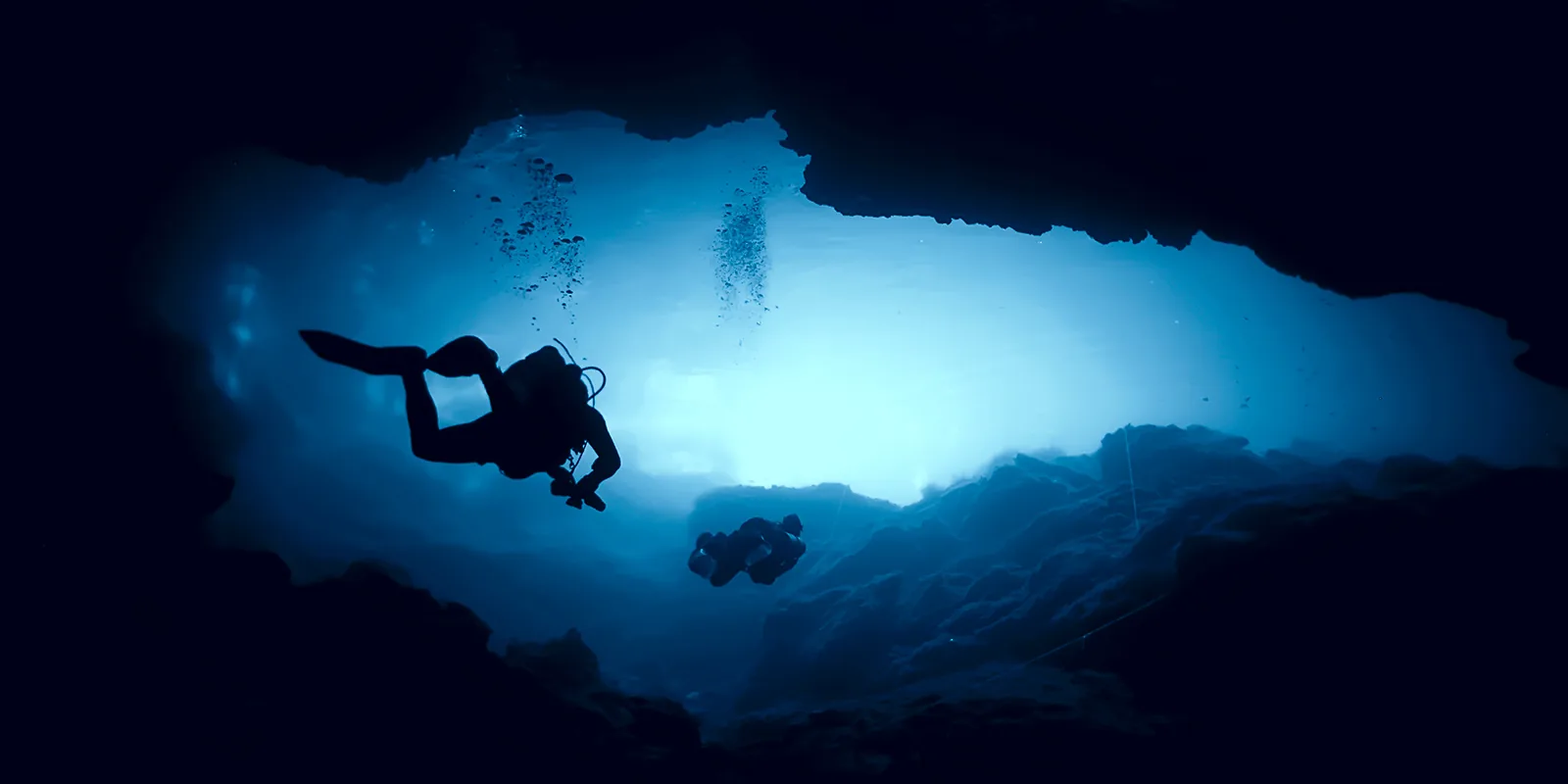
Cavern diving remains within the natural-light zone and follows strict recreational cavern limits. A certified recreational diver may be considered for an appropriate itinerary, but certification alone does not automatically make every cenote suitable.
The selected route must match the diver’s recent experience, buoyancy control, trim, comfort in confined spaces, physical condition, and ability to follow precise instructions. The guide retains final authority over site selection and participation.
Cave diving continues beyond the daylight zone into a true overhead environment. There is no direct vertical ascent to the surface. Permanent and temporary guidelines, gas management, redundancy, propulsion technique, team positioning, emergency procedures, and environmental awareness become essential.
Cave dives are available only to divers holding the certification and recent experience appropriate to the selected route. A recreational certification, cavern experience, or confidence in open water does not replace formal cave training.
Adventure Tours Isla Mujeres can organize customized cavern and cave training, including the progression from cavern procedures into formal cave-diving levels, configuration-specific preparation, and related technical development.
Training is not treated as a quick tourism add-on. Before a program is accepted, the candidate’s certification, recent diving, buoyancy, trim, propulsion, gas awareness, equipment familiarity, discipline, schedule, and training objective must be reviewed.
Not every inquiry will immediately result in course enrollment. A candidate may first need additional open-water practice, low-visibility or night experience, equipment work, or other preparation before entering an overhead-environment program. Training options can also be reviewed on our SDI and TDI Certifications page.
The terms are often used together, but operationally they describe different environments. The visible entrance does not make an entire system a cavern, and clear water does not remove overhead risk.
Possible sites include Dos Ojos, Tajma Ha, Dream Gate, Angelita, The Pit, Calavera, Ponderosa, Chak Mool, Grand Cenote, and other suitable systems near Playa del Carmen and Tulum.
These are not interchangeable attractions. Each cenote has a different combination of access, depth, natural light, passages, formations, haloclines, open-water areas, overhead limits, physical effort, and equipment requirements.
The final site or combination is selected according to:
A particular cenote, route, light effect, halocline, hydrogen sulfide layer, or geological feature cannot be guaranteed until the complete plan has been reviewed.
The peninsula’s porous limestone allows rainwater to move underground rather than forming extensive surface rivers. Over long periods, that water dissolved and shaped the rock, creating passages, chambers, collapses, and cenote openings.
Stalactites, stalagmites, columns, and other mineral formations developed when sections of these caves were dry. Later changes in sea level flooded many passages, preserving formations that divers can now observe underwater.
In some systems, freshwater lies above denser saltwater. The transition is called a halocline. Passing through it can temporarily distort vision and create the appearance of layers moving across one another.
Certain cenotes are known for unusual layers or clouds, including hydrogen sulfide in specific environments. These phenomena depend on the selected site and route and are not present on every dive.
Standard recreational cavern equipment may include tanks, BCD, regulator, weights, fins, mask, wetsuit, and appropriate lighting. The exact configuration depends on the site, route, diver, guide requirements, and whether the activity is cavern, cave, or training.
Certified cave diving and cave training may involve doubles, sidemount, multiple lights, reels, spools, stage cylinders, decompression cylinders, backup masks, cutting devices, and other redundant equipment. These are not automatically included in the starting price.
Doubles or sidemount can be considered when the diver is trained and the configuration is appropriate to the selected route, gas plan, access, course objective, and available support. Equipment is never assigned solely because a configuration is popular.
Cenote water can be exceptionally clear, but visibility does not make an overhead environment forgiving. Safe operation depends on procedures that remain effective when light, visibility, orientation, equipment, or communication changes.
The selected plan may be changed or canceled if the guide or instructor determines that certification, readiness, equipment, access, or conditions do not support the intended objective.
The cenotes are located on the mainland, primarily in the Playa del Carmen and Tulum regions. The day therefore combines ferry travel, private ground transportation logistics, site access, equipment preparation, diving, surface intervals, and the return to Isla Mujeres.
We coordinate the itinerary so the diver does not have to assemble separate ferry, vehicle, guide, equipment, and cenote arrangements. Exact inclusions, transportation charges, entrance fees, meeting points, and equipment requirements are confirmed in the written proposal before payment.
Guests arriving from Cancún, Costa Mujeres, or another mainland location may receive a different meeting plan. Private marine transportation can also be reviewed through Aqua Taxi 24/7 when appropriate.
The complete day is approximately 9 to 10 hours, including ferry and ground transportation time. A typical itinerary may be:
This is an operational example, not a guaranteed minute-by-minute schedule. Training programs, more distant sites, complex equipment, cave-diving objectives, and access conditions may require a different plan or multiple days.
Bring your certification card, towel, sunglasses, hat, insect repellent, and suitable footwear for stairs, rocks, wet surfaces, and uneven terrain. Moderate physical effort may be required at some cenote entrances.
Before confirmation, provide:
Private Cavern Diving
MXN $5,000
starting price
(The final total is confirmed after reviewing the cenote, transportation, entrance fees, equipment, guide requirements, and itinerary.)
The starting price is not a universal price for every cenote, cave route, technical configuration, transportation plan, or training program. Final cost depends on the selected objective, participants, transportation, entrance fees, equipment, cylinders, gases, guide or instructor requirements, and number of days.
Complete the form below with your preferred dates, certification level, logged dives, recent experience, desired cavern, cave, or training objective, equipment configuration, hotel location, and number of participants.
The request will be reviewed before a site, itinerary, price, and deposit are confirmed. For specialized cave diving or training, contact us directly through WhatsApp.
Review Dive Sites Around Isla Mujeres, then prepare for more demanding environments through Adventure Diving and Offshore Expeditions, develop nighttime procedures with a Night Dive, or maintain open-water skills through Reef Diving. Training candidates can review SDI and TDI Certifications. Non-certified companions may prefer Try Scuba or Snorkeling. Learn more about the company on our About Us page.